

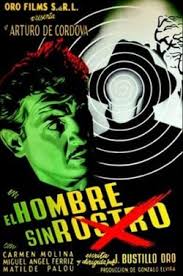
There have been several horrible murders lately. Young women have been viciously killed. There seems to be no pattern to the crimes other than that they were all women. It doesn’t matter their age, race, or what they do for a living. The press calls him the Mutilator. The police doctor, Dr. Eugenio Britel (Miguel Angel Ferriz) believes that someone with some medical knowledge is the perpetrator. The lead investigator on the crimes is Juan Carlos Lozano (Arturo de Cordova). After months of investigation Juan Carlos is no closer to apprehending the murderer than he was when he first started his investigation.
The entire investigation has been weighing heavily on Juan Carlos. He has been having vivid nightmares where a man with no face taunts him. Juan Carlos is on the verge of a nervous breakdown and wants to quit but the chief of detectives (Julio Daneri) refuses to let him. Eugenio observes Juan Carlos’ condition and offers to help him. Juan Carlos describes his visions of a killer as a man with no face. The dreams are drenched in symbolism and shadows. As Eugenio tries to analyze and interpret the dreams, Juan Carlos’ continues to have night terrors. The killings continue.
As Juan Carlos explains his visions and feelings to Eugenio, the doctor begins to uncover events from Juan Carlos’ past that have to do with his overbearing mother (Matilde Palou). Eugenio suspects that the relationship between Juan Carlos and his mother may be at the heart of Juan Carlos’ breakdown. Eugenio also learns of Ana Maria (Carmen Molina), Juan Carlos’ fiancé and the adopted daughter of his mother. When Juan Carlos’ mother hears of the marriage between the two, she does everything she can to keep them apart, including feigning illness. All of these puts added pressure on Juan Carlos and his ability to hunt down the maniac who is killing women indiscriminately.
“The Man Without a Face” AKA “El hombre sin rostro” was released in 1950 and was directed by Juan Bustillo Oro. It is a rather obscure Mexican mystery thriller with some horror elements.
The movie is slightly melodramatic and a little bit soap opera-y but it has some wonderful Salvador Dali-esque dream sequences that are actually creepy and surrealistic. They are almost noir with lots of gothic and expressionistic touches. The dreamy atmosphere adds a lot to the sometimes overemotional film. The performances of the main actors are also pretty good which helps make the film a nice watch. It’s not exactly horror but more of a psychological thriller.
The movie is showing shades of Jack the Ripper, but the focus is not on the murders but on Juan Carlos’ reactions to his inability to solve them. It’s different than the usual Mexican horror film. It may not be too difficult to figure out who the murderer is but that’s not really the point of the film. Steeped in psychological drama the movie is more of a case study in the human psyche rather than a murder mystery.
The monster was played by former Mexican wrestler Wolf Ruvinskis.