

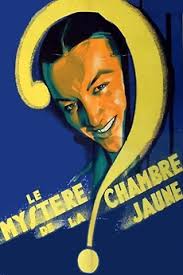
Professor Stangerson (Maxime Desjardins) and his daughter, Mathilde (Huguette Duflos) are attending an event with Mathilde’s fiancé, Robert Darzac (Edmond Van Daele). Mathilde and Robert are to be married in a day or two. The press is attending the event, looking to get an interview with any of the three. Among the reporters is Joseph Rouletabille (Roland Toutain).
After the event, Mathilde and the Professor return home to their estate, Chateau du Glandier. The maid, Marie (Kissa Kouprine) informs her that she has prepared Mathilde’s room and has locked the windows. Mathilde retires for the night, to the yellow room, and locks her bedroom door. Inside her room someone is hiding under the bed. Shots are heard and a woman screams. The Professor and his assistant, Pere Jacques (Henri Kerny), hear the noise from the laboratory situated next to the yellow room.
When they try to open the door to the room they find it locked. Servants from all over the castle rush to break down the door. Inside they find Mathilde alive but wounded and unconscious. Near her is found the gun. Everything else is locked, and no one else was in the room. The police are called as reporters gather at the main gate. Inspector Frederic Larsen (Marcel Vibert) arrives to take charge. The Inspector ends up stymied. The clues point to Mathilde’s fiancé Robert as the culprit but looks can be deceiving. It’s not until reporter and amateur sleuth Joseph Rouletabille arrives that the crime can be solved.
“The Mystery of the Yellow Room” AKA “Le mystère de la chambre jaune” was released in 1930 and was directed by Marcel L’Herbier. It is a French mystery thriller. The film is based on the 1907 novel by Gaston Leroux.
There have been several film renditions of the story, including 1913 French and 1919 American silent versions, a Spanish version from Argentina done in 1947, and additional versions, both French, released in 1949 and 2003. I believe there is also a made for TV French version done in 1965. A sequel called “The Perfume of the Lady in Black”, also penned by Leroux, was released in 1931 and also featured the reporter detective Rouletabille.
This thing is really creaky. The story is slightly more complex than I expected and some of the epiphanies discovered by Rouletabille seemed a little far reaching. The actual locked room aspect of the movie is lost in all the other things going on, which makes the actual locked room aspect a bit of a MacGuffin. Still, there’s action and a red herring or two to keep you mentally occupied. It is fine for what it is, an old who-done-it.
The book itself is considered one of the best mysteries ever written and this version is also considered one of the earliest French “locked room” mysteries.